


PATENTS
What Is a Patent?
Una Patente es un derecho exclusivo que se concede sobre una invención. En términos generales, faculta a su titular a decidir si la invención puede ser utilizada por terceros y, en ese caso, de qué forma. Como contrapartida de ese derecho, en el documento de Patente publicado, el titular pone a disposición del público la información técnica relativa a la invención.
Types of Patents
Patent
An invention can be a product (a device, a chemical compound) or a process (a manufacturing method). Mere scientific discoveries, mathematical theories, artistic works, or business plans are not considered inventions.
In short, an invention is the creative act that gives rise to something functionally new.
Design Patent
This refers to any three-dimensional form, whether or not combined with colors, and any industrial, commercial, or domestic object or utensil that can serve as a model for the production or manufacture of others and that differs from similar items due to its distinct shape or configuration.
Industrial Design Patent
This refers to any arrangement or combination of lines, colors, or both, intended to give any industrial product a distinctive appearance.
Patentability Criteria
New
The invention must not be included in the “state of the art,” which encompasses anything that has been made available to the public prior to the patent application date through a written or oral description, a sale, public use, or any other means.
Inventive step (or inventive level, non-obviousness)
An invention is considered to have an inventive step if, to a person skilled in the relevant technical field, the invention is not obvious and does not follow naturally from the prior art.
Aplicación industrial
The invention must be capable of being manufactured or used in any type of industry, including agriculture, healthcare, services, etc.


Benefits Granted to the Holder of a Registered Patent
1.- Protects el derecho exclusivo sobre una invención en todo el territorio nacional, permitiéndole controlar su fabricación, uso, comercialización e importación, e impide que terceros la exploten sin su autorización.
2.- Allows el acceso a incentivos fiscales y financiamiento para proyectos de I+D, al vincular el registro ante el SAPI con la Ley de Ciencia, Tecnología e Innovación.
3.- Otorga a las empresas de los sectores industrial, petroleros y agroalimentario una ventaja competitiva clave en la contratación pública e impulsan sus posibilidades de éxito en licitaciones y alianzas con el Estado
4.- Garantiza la celebración de contratos de transferencia de tecnología (cesión o licencias) con empresas públicas o privadas, generando ingresos mediante regalías por el uso o explotación de la tecnología protegida.
Download illustrated guides and forms
- Guía de proceso de Registro de Patentes
- Descriptive Specification for an Industrial Design Patent (Structure)
- Descriptive Specification for a Patent or Utility Model (Structure)
- Application Form for Access to Industrial Property Records
- Patent Registration Certificate Form
- Guide to the Examination of Patent Applications
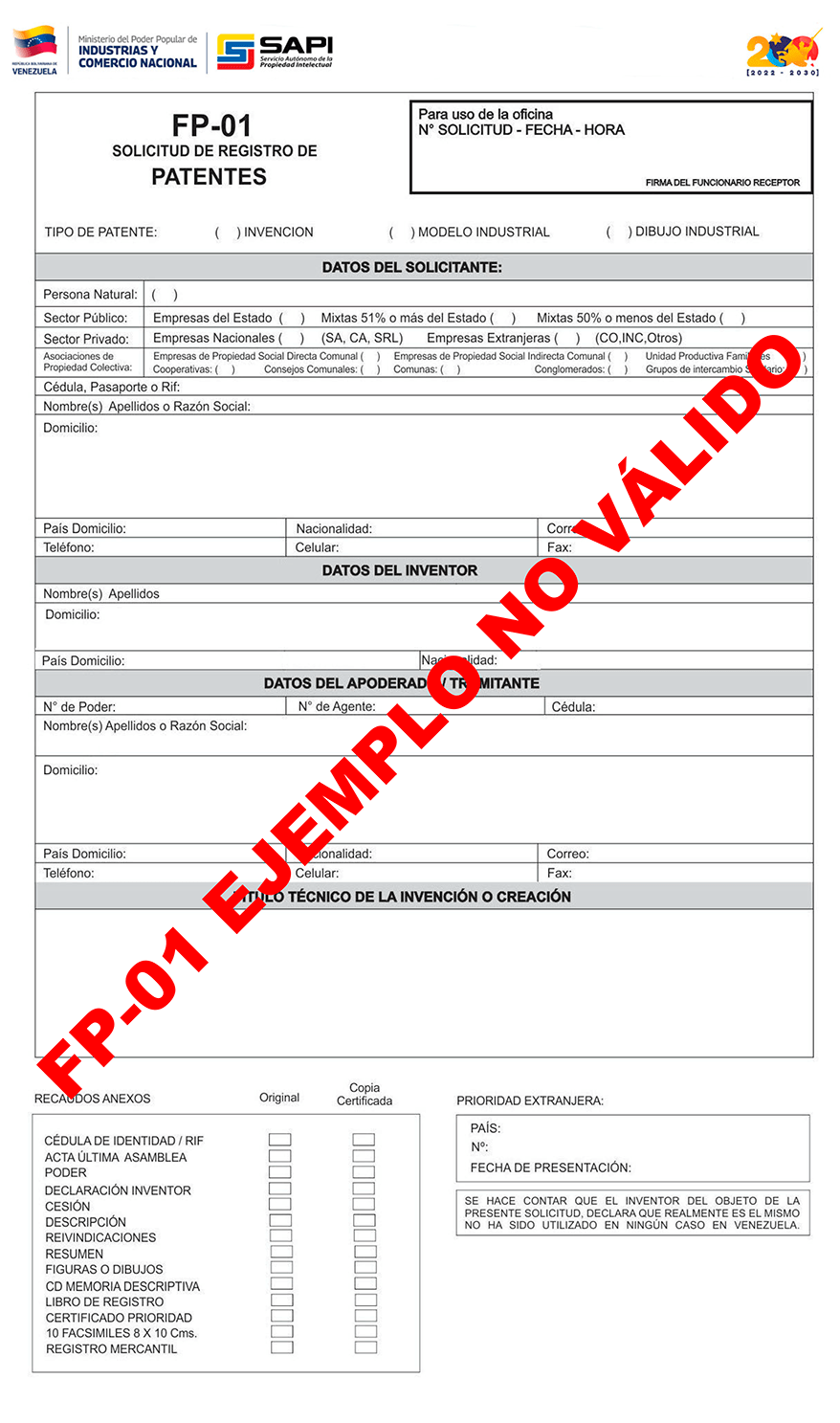
- PlanillaFP-01
Tarifas y cuentas bancarias
Multimedia
Gallery